
Neurofeedback for ADHD What Parents in Vancouver and Langley Ask Me First
“What does neurofeedback actually do?”
That is usually one of the first questions parents ask me about neurofeedback for ADHD. Most are not looking for another broad promise. They want to know what happens during training, whether it is appropriate for their child, and how anyone will know whether it is helping.
For over 20 years, I have worked with neurofeedback and brain training. I work with families in Vancouver and Langley, throughout British Columbia, and internationally through remote programs. The children are not all alike. Some have a formal ADHD diagnosis. Others are bright or possibly twice-exceptional children whose parents are still trying to understand an uneven pattern of attention, regulation, and daily functioning.
What happens during neurofeedback?
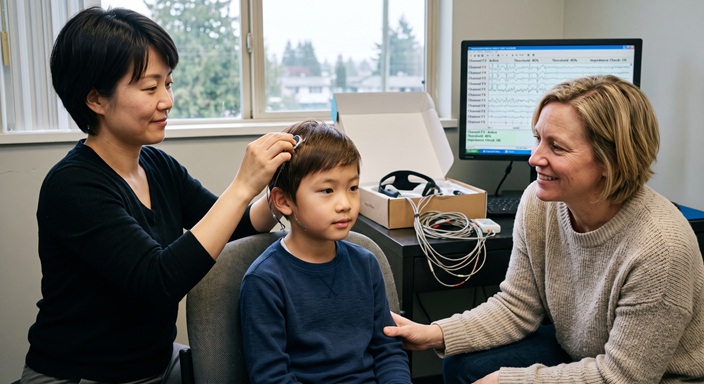
Neurofeedback is a form of biofeedback based on the brain’s electrical activity. Sensors placed on the scalp record EEG activity; they do not send electricity into the brain. Software converts selected features of that activity into immediate visual or auditory feedback while the child watches a screen or completes a training activity.
The simplest explanation is that the feedback makes aspects of brain activity observable in real time. A training protocol defines which features receive feedback, and those features may differ according to the system and the goals of training. Neurofeedback is therefore not one uniform procedure, and the name alone does not tell parents what protocol, measurement, or clinical reasoning is being used (Loriette et al., 2021).
That distinction matters. When a parent asks whether neurofeedback “works,” I first separate the technology from the training plan. I want to know what is being trained, why that target was selected, how the child’s day-to-day concerns were defined, and what will be measured outside the training session.
Parents also ask whether a child needs to concentrate perfectly during a session. The child participates, but the purpose is not to pass a test or force the brain into a particular state. The feedback is part of a structured learning process. A difficult session does not establish failure, just as one calm session does not establish a meaningful change.
What is often neglected in ADHD and ASD support?
A child’s development is never explained by one element. Self-confidence, communication, motivation, interest, curiosity, psychological experience, nutrition, and physiology may all matter. Families may already be working thoughtfully in several of these areas.
In my experience, the brainwave connection is one of the most neglected categories when support is being planned for children with ADHD or ASD. Brainwave rhythms do not replace psychology, learning, nutrition, relationships, or developmental understanding. They add another way of looking at how the brain organizes activity from moment to moment.
Please allow me to use a simple hardware-and-software analogy. It is a teaching analogy, not a literal scientific division of the brain. Within this analogy, I describe psychology, communication, and learned skills as part of the “software.” I call neurofeedback training work with the “hardware” of attention and mood regulation because it trains with real-time information drawn from electrical brain activity.
I look at brainwave rhythms in relation to the cadence of attention: how readily attention shifts, engages, sustains focus, refocuses, and keeps up mental agility. Brainwave information does not explain the whole child, and no single rhythm stands for one behaviour, emotion, or diagnosis. The hardware analogy simply helps parents understand why motivation and communication may not be the only categories worth exploring.
For many parents, this opens a useful new question. If a family has already considered confidence, routines, motivation, school support, and emotional needs, has anyone also looked carefully at the brain’s electrical rhythms and the child’s capacity to regulate attention? That question is often where curiosity about neurofeedback training begins.
Why is parent coaching part of the training plan?
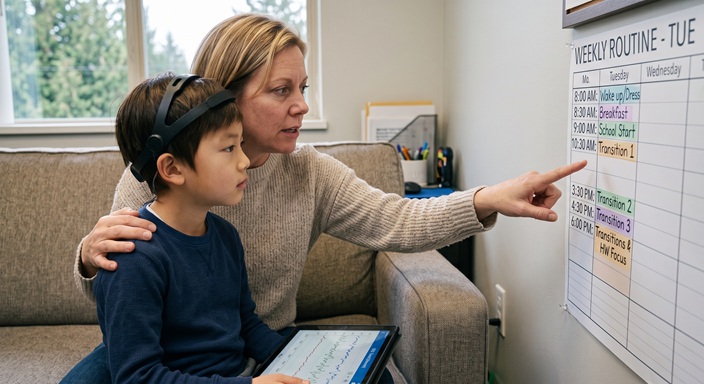
Neurofeedback is not the whole program I provide. In our model, parent coaching is as critical as the neurofeedback training itself. While the child trains, I work with parents to connect what we gather to what happens in daily life—during schoolwork, transitions, sleep, meals, emotional moments, relationships, and family routines.
Families often arrive knowing what keeps happening but still wondering why the pattern repeats. Parent coaching helps us slow the sequence down. What tends to happen before attention drops? What makes one transition manageable and another difficult? When does a child recover more readily? Which supports build independence, and which situations still require repeated adult involvement?
Many parents describe this as wanting to understand the “root cause.” I respect that question while remaining careful with the language. ADHD and ASD are complex developmental conditions, and a child’s daily difficulty is rarely explained by one hidden cause. I look instead for interacting contributors—neurophysiology, development, learning, mood, sleep, nutrition, demands, environment, and relationships—without blaming the child or the parent.
In my hardware-and-software analogy, neurofeedback training uses information from the brain’s electrical activity, while parent coaching helps the family understand the child’s patterns and shape the psychological, relational, and environmental conditions around the training. Parent participation also aligns with guideline-based ADHD care, which includes parent training in behaviour management as an important component of care, depending on age and the individual plan (Wolraich et al., 2019).
That is why progress reviews aren’t limited to EEG data. Parents learn which observations matter, what changes are emerging, and where the child is still struggling. The training plan and the family’s approach can then develop together rather than operating as two separate efforts.
What does the research show?
The research does not give one simple answer for every child or every protocol. A 2025 systematic review and meta-analysis of 38 randomized clinical trials found no meaningful benefit for core ADHD symptoms when outcomes came from probably blinded raters. Small effects appeared in some unblinded or protocol-specific analyses, but the authors concluded that the overall evidence did not support neurofeedback as a stand-alone approach for ADHD symptoms (Westwood et al., 2025).
Other recent syntheses have reached more favourable conclusions for certain neurofeedback approaches or outcomes, which helps explain the field’s ongoing debate about protocol, control conditions, learning, and outcome measurement. A 2024 network meta-analysis of trials involving children aged 5 to 11 reported improvement for several neurofeedback approaches relative to control conditions, while also noting variation across protocols and evidence quality (Wu et al., 2024).
Taken together, the research does not justify saying that neurofeedback will improve every child’s ADHD symptoms. It also does not make every protocol interchangeable. The more useful question is individual: does the assessment suggest that this child is an appropriate candidate, what would be trained, and how would meaningful progress be monitored?
I do not advise families to discontinue medication, counselling, school support, or other established care because neurofeedback training is being considered. The American Academy of Pediatrics recommends a care plan that reflects the child’s age, needs, family preferences, and evidence-based medication and behavioural supports (Wolraich et al., 2019). Neurofeedback training should be discussed within the child’s broader care, not presented as a guaranteed replacement.
I believe parents can be curious about neurofeedback without being asked to accept a sweeping promise. An assessment and careful conversation can show whether the option is worth exploring. If it is not the right fit, that is also useful information.
Can neurofeedback training be remote?
Parents often arrive with a diagnosis but a much more specific daily question. A child may understand schoolwork yet take a long time to begin, become dysregulated during transitions, or require repeated adult involvement to complete ordinary routines. Those are the functional patterns I want defined before discussing training.
The first step is to turn a general wish such as “better focus” into observable targets. That might mean how often a child returns to homework after distraction, how much prompting is needed to begin a routine, or whether regulation changes across the school day and evening. The targets must be meaningful to the family and measurable without forcing every change into an EEG number.
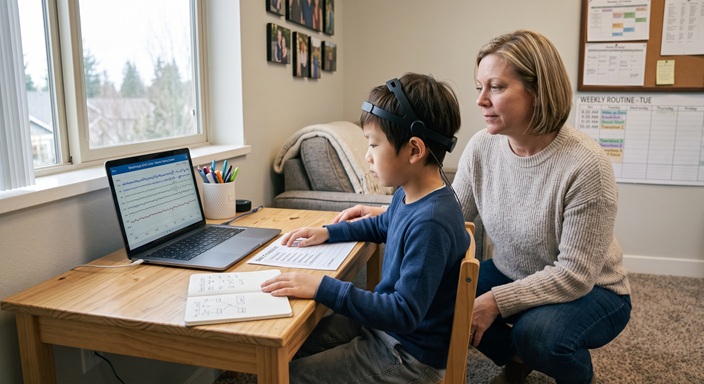
Advanced technologies now make carefully monitored remote neurofeedback training possible for appropriate candidates. Remote training does not mean sending equipment home and leaving a family to manage alone. It requires a defined training plan, reliable equipment setup, clear instructions, and specific clinical oversight.
In our remote model, I can monitor completed sessions, training minutes, signal quality, feedback thresholds, and trends within the targeted training data. Scheduled reviews are also parent-coaching conversations: we connect the data with the family’s observations of attention, mood regulation, daily routines, and schoolwork. Technical check-ins can address sensor placement, equipment use, and interruptions before they quietly affect training quality.
This combination allows you to review training data and everyday functional changes together. When the information indicates that the plan needs adjustment, the protocol or training targets can be reviewed rather than leaving the same settings in place automatically.
Remote delivery does not automatically reduce effectiveness when candidacy, equipment, signal quality, consistency, and progress are monitored precisely. In some cases, I find remote training more effective in practice because it removes travel, allows more consistent training, and lets the child train in a familiar environment. This is my clinical observation, not a claim that remote training is inherently better for every child.
I also consider whether the child can participate comfortably, whether the family can sustain the recommended schedule, and whether another need should be addressed first or alongside training. Neurofeedback can require repeated sessions, and the appropriate number cannot be promised from a headline or a diagnosis alone. Parents should receive a clear explanation of the proposed protocol, remote-monitoring plan, costs, and criteria for reviewing progress before committing.
For families in Vancouver and Langley, elsewhere in Canada, and internationally, remote training can create another carefully monitored option when the child is an appropriate candidate. My role remains the same: to connect the training data to the whole child. For a bright or possibly 2e child, that means keeping intellectual strengths visible while examining the regulation and functional difficulties that may be hidden behind acceptable performance.
For families curious about neurofeedback for ADHD, I invite parents to request a complimentary call with the Breakthrough ADHD Center team. The call provides a place to discuss the child’s concerns, what parents hope to change, and whether an assessment for neurofeedback candidacy may be a useful next step. It is also an opportunity to learn how parent coaching and neurofeedback training work together in our program. Local and international families are welcome to explore whether remote or in-clinic training is the more appropriate option. Families can request a call here.
Frequently Asked Questions
Is neurofeedback non-invasive?
Yes. EEG sensors record electrical activity from the scalp and do not deliver electrical current into the brain. Parents should still ask how the equipment is cleaned, how comfort is monitored, and what a session involves.
Can neurofeedback diagnose ADHD or ASD?
No. Neurofeedback is training, not a diagnostic process. ADHD or ASD diagnosis requires evaluation by an appropriately qualified professional using developmental history, symptoms, functioning across settings, and other relevant information. EEG and training data may add information about brain activity, but no single brainwave pattern diagnoses ADHD or ASD (Wolraich et al., 2019).
Is neurofeedback the same at every clinic?
No. Clinics may differ in the populations they serve, the EEG features and protocols they use, how they design feedback, and how they monitor progress. As our name indicates, Breakthrough ADHD Center specializes in children with attention and mood-regulation concerns. That specialization shapes how I connect the child’s assessment, daily functioning, training targets, and progress reviews rather than applying the same protocol to every child.
How many sessions are needed?
I do not begin by recommending a universal number of sessions. I recommend completing an assessment first to determine whether neurofeedback training is appropriate for the child and to identify what the training plan should address. The proposed schedule can then reflect the individual findings, the child’s participation, the goals being monitored, and regular reviews to ensure the plan remains appropriate.
Can medication continue during neurofeedback?
Medication decisions belong with the prescribing clinician. Neurofeedback training should not be used as a reason to stop or change prescribed medication without that clinician’s guidance.
What is the parent’s role during neurofeedback training?
Parents are active partners in our program. Parent coaching runs alongside the child’s neurofeedback training so that daily patterns, possible contributing factors, and functional changes can be understood more clearly. Reviews connect the training data with what parents observe at home and school, helping the training plan and the family’s approach develop together.
Can neurofeedback training be completed remotely?
Yes, remote neurofeedback training may be available when the assessment indicates that the child is an appropriate candidate and the family can support the setup and schedule. This option allows us to work with suitable families in British Columbia, elsewhere in Canada, and internationally. We can review training data, signal quality, completed minutes, feedback thresholds, and functional targets remotely. The initial call and assessment clarify whether remote or in-clinic training is more appropriate.
References
Loriette, C., Ziane, C., & Ben Hamed, S. (2021). Neurofeedback for cognitive enhancement and intervention and brain plasticity. Revue Neurologique, 177(9), 1133–1144. https://doi.org/10.1016/j.neurol.2021.08.004
Westwood, S. J., Aggensteiner, P. M., Kaiser, A., et al. (2025). Neurofeedback for attention-deficit/hyperactivity disorder: A systematic review and meta-analysis. JAMA Psychiatry, 82(2), 118–129. https://doi.org/10.1001/jamapsychiatry.2024.3702
Wolraich, M. L., Hagan, J. F., Jr., Allan, C., et al. (2019). Clinical practice guideline for the diagnosis, evaluation, and treatment of attention-deficit/hyperactivity disorder in children and adolescents. Pediatrics, 144(4), e20192528. https://doi.org/10.1542/peds.2019-2528
Wu, G., He, Q., Li, D., Zhang, Z., Miao, J., & Shu, Y. (2024). Comparative efficacy of neurofeedback interventions for attention-deficit/hyperactivity disorder in children: A network meta-analysis. Brain and Behavior, 14(12), e70194. https://doi.org/10.1002/brb3.70194